



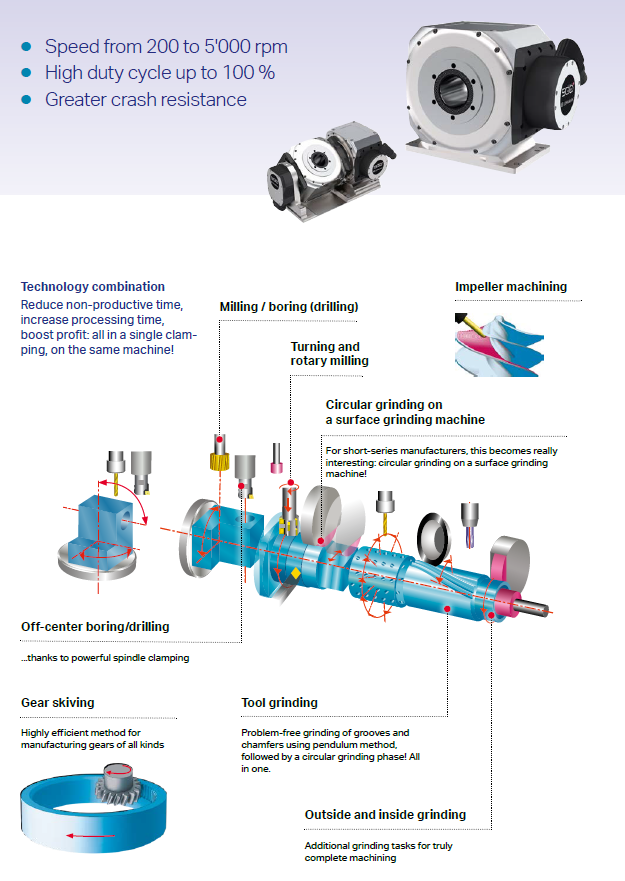
Worm gears or roller gears are particularly well-suited for CNC rotary tables because they achieve a large gear ratio in a small space, often self-locking, and high precision. However, this places high demands on bearing and sealing technology and requires excellent, twist-free spindle clamping for precision work. In contrast to direct-drive rotary tables (DD), however, rotational speeds are significantly lower and they are considerably more susceptible to tangential collisions. Against this background, geared rotary tables are ideally suited for precision work, moving large loads, and when high machining forces or inertia are involved. They are typically used for milling, drilling, and grinding, whereas direct-drive rotary tables are suitable for high dynamics or when rotational operations are required.
Advantages
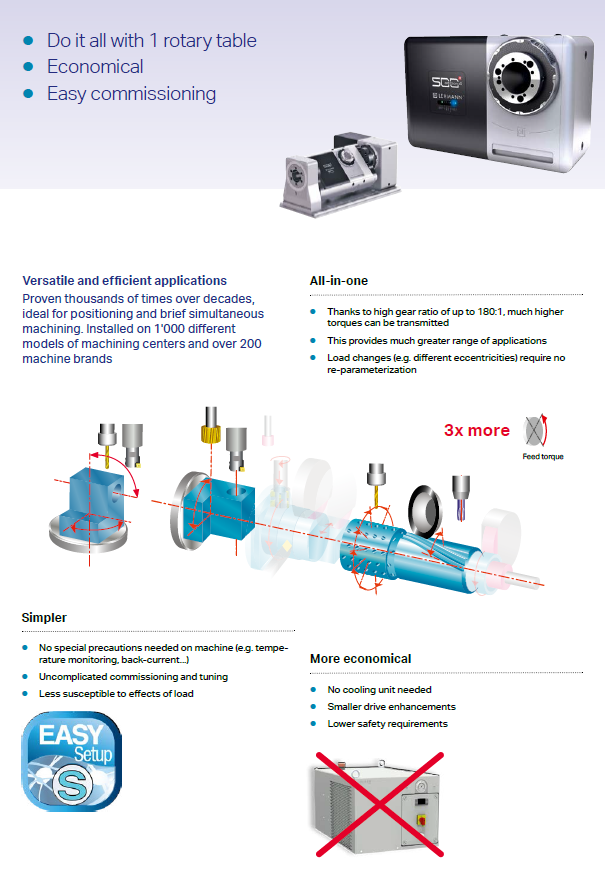
Modern gear-driven rotary tables are equipped with zero-backlash preloaded gears, e.g. Roller-CAM gears or PGD gears from pL LEHMANN. This eliminates a major disadvantage of conventional worm gears. Compared to the DD rotary table, they offer:
– significantly higher stiffness
– significantly reduced impact sensitivity
– high accuracy
DD turntables, on the other hand, have the following advantages over geared turntables:
– symmetrical external dimensions and therefore thermally and mechanically easier to handle
- much higher speeds possible
– usually significantly more dynamic in operation
Special feature at pL LEHMANN: The self-developed PGD (preloaded gear drive) combines the advantages of geared rotary tables with those of DD rotary tables, as long as speeds of over 200 rpm are not required for extended periods. In terms of dynamics, it is even significantly superior to many DD rotary tables, thanks to the exclusive, super-fast spindle clamping. The PGD drives also have significant and advantageous differences compared to Roller-CAM drives:
– genuine preload, not just fitted
– all-round precision-ground contact surfaces
Excellent damping properties
– high concentricity, which brings excellent results, particularly in grinding operations
Disadvantages
Many geared rotary tables have the following disadvantages:
– Tangential collisions or tool breakages can damage the gearbox and lead to expensive repairs
Due to the reversal game, absolute accuracy is limited.
– The gearbox backlash will need readjusting over time, but with one-sided wear, this can later restrict the angle of movement (unused areas jam).
These disadvantages have been largely overcome by pL LEHMANN with the two PGD gearbox versions. The HIGH gearbox masterfully absorbs shock loads of over a factor of 10 of the permissible torque.
Frequently Asked Questions
Why aren't PGD gearboxes from pL LEHMANN used more often, actually?
Answer: because the knowledge is often still too little widespread or the price is assumed to be too high. However, the latter should be critically questioned, because the PGD gears from pL LEHMANN are hardly significantly more expensive than the predominantly Asian competition when compared correctly.
Why aren't only DD turntables used, since they are significantly simpler in terms of design, often more compact in terms of space (because they are symmetrical), and also much faster?
Answer: To transmit a continuous torque of, for example, 150 Nm, a DD rotary table with a 2 to 4 times larger volume is required. In addition, a significantly larger drive amplifier is often needed, which in turn results in higher one-off and operating costs.
When are traditional worm gears actually still used?
Answer: for special applications in terms of design, load and cost requirements, or whenever precision and speed are not critical.
 German
  Polish
  Spanish
  English