



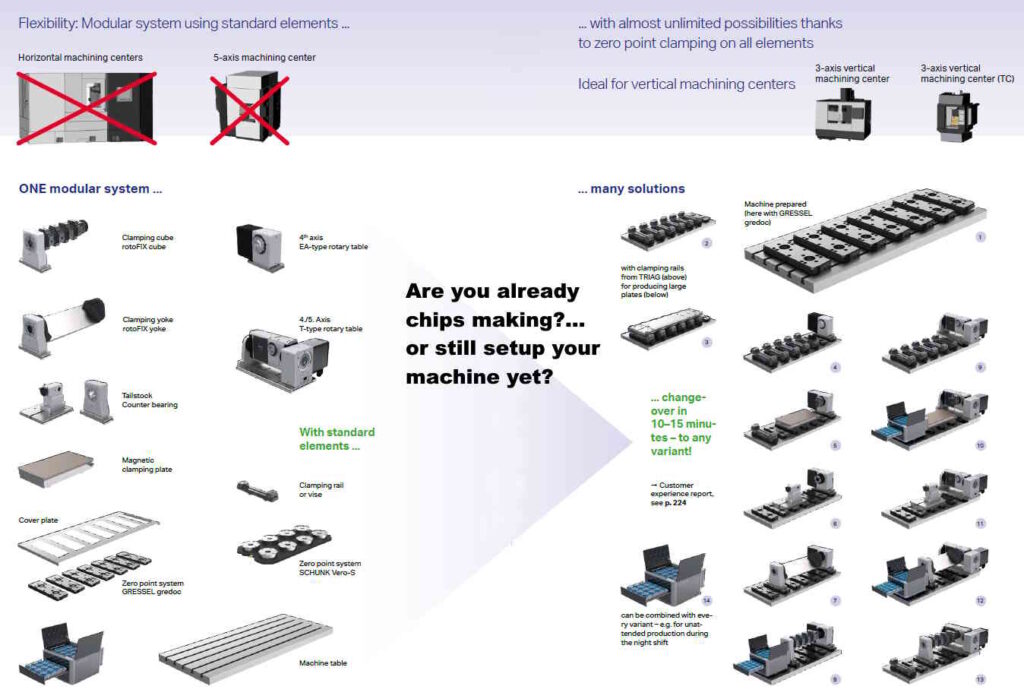
If a CNC machine and the additional rotary table, along with a possible tailstock centre for shaft machining, are also equipped with a zero-point clamping system, the 3-axis machine can be converted into a 4-axis or even a fully-fledged 5-axis machine in the shortest possible time (and also by non-specialists), including simultaneous machining. Currently, only pL LEHMANN offers this with the QUICKpLEX system from rotary table manufacturers.
Advantages
It goes without saying
– shortest possible conversion time in minutes instead of hours
– High repeat accuracy in the space of all exchangeable elements, as these are repositioned with zero-point clamping in all axes to within 0.005mm, which in many cases makes re-measuring/aligning unnecessary
– partially or fully automatable retooling
Disadvantages
Depending on the chosen zero-point clamping system (pL LEHMANN offers other systems besides LANG Quickpoint, such as SCHUNK, EROWA, ZEROCLAMP, AMF, etc.):
Accuracy not sufficient
– expensive, as it needs to be converted too rarely (ROI too weak)
– Holding forces too low, which however is mainly realistic in the case of heavy machining
Frequently Asked Questions
Which zero-point clamping system is the best?
Answer: That depends entirely on your needs. For general metal cutting, LANG Technik's QuickPoint system has become established worldwide. For higher demands, systems from Schunk, Zeroclamp, or AMF are suitable, and for the highest demands, EROWA and System 3R are in the leading position.
Can I completely do without a probing system on the machine?
Answer: Partly yes, but here too the exact requirement must be clarified and weighed against the advantages and disadvantages.
 German
  Polish
  Spanish
  English