



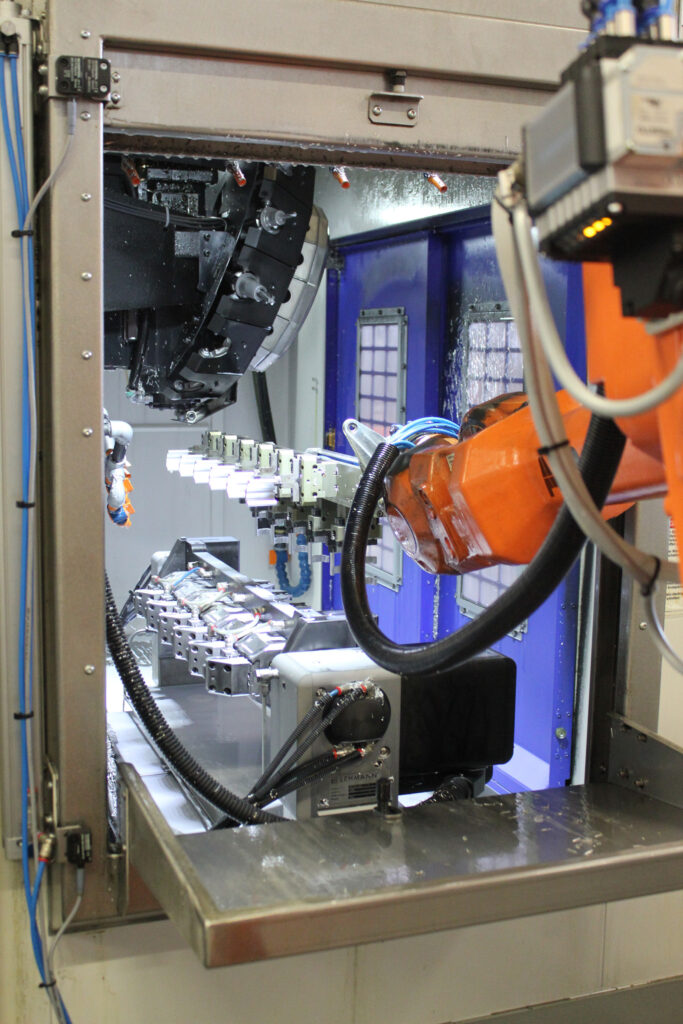
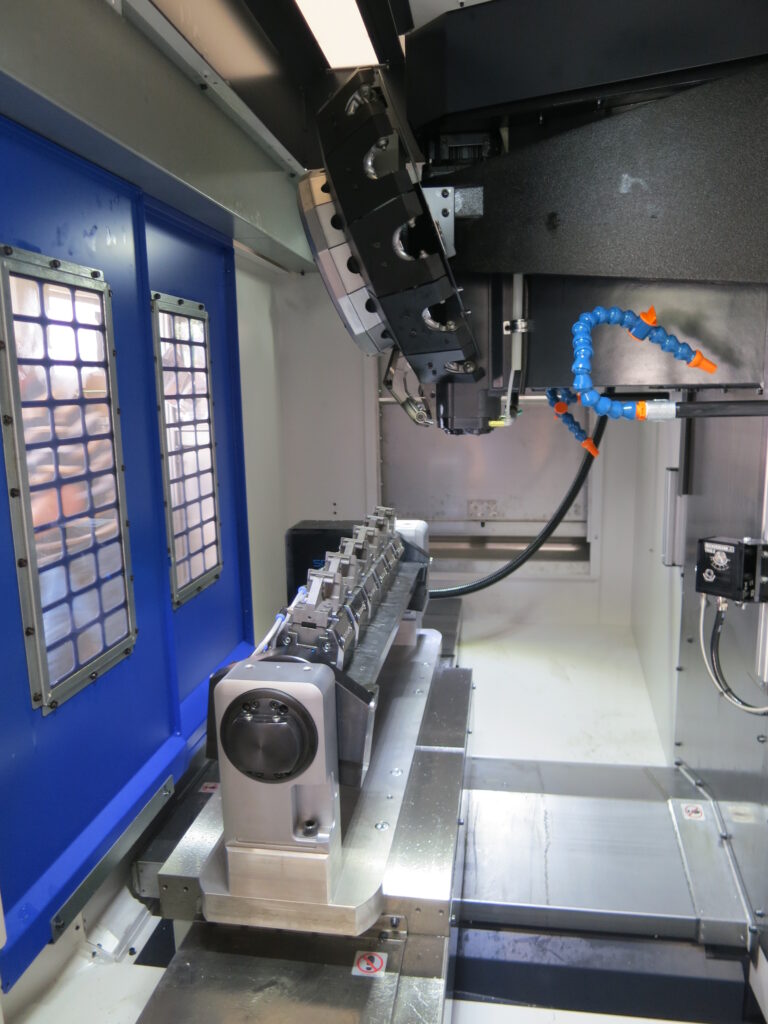
Small, fast, and series-producible standard machines like the Fanuc Robodrill have replaced transfer lines in many areas of the automotive industry: increasing variant diversity and declining production runs have drastically increased the demands for flexibility.
Advantages
The advantages are obvious:
- Universally buildable on the machine
– can be equipped with a wide variety of clamping systems
– Zero-point voltage combined with automatic workpiece clamping in one: The new VOLEX system, as an expansion of the modular system, enables fixture changes and workpiece handling with a robot in one – pure flexibility
– scalable production in small steps
Disadvantages
Compared to specialised machine concepts for the automotive industry, such as those offered by Grob, Chiron or SW, the planning effort when using a pL LEHMANN rotary table is heavily dependent on the respective machine manufacturer or integrator. The end customer can save themselves this uncertainty with a specialised manufacturer – albeit often at a considerable cost.
Frequently Asked Questions
How is it possible to operate high-volume production with small standard machines? Surely today, the focus is more on multi-spindle machines with full automation? Answer: Let's take 4 tapping centres, each equipped with a twin-spindle trunnion-type table, with automatic clamping technology and the appropriate automation. Productivity is usually higher in practice, the footprint is smaller and, most importantly, if one spindle fails, 3 spindles continue to work. Which multi-spindle machine offers that?
 German
  Polish
  Spanish
  English