




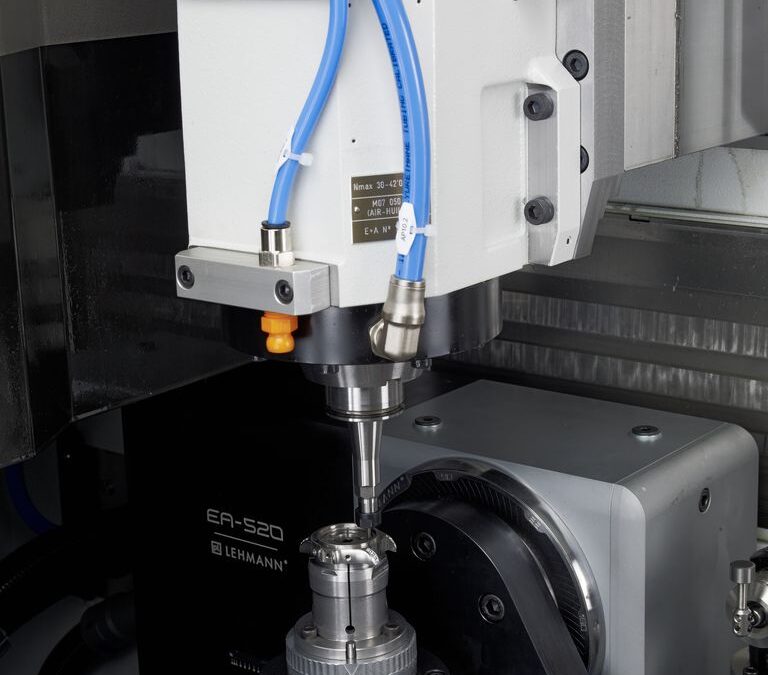
A rotary table application tailored to the workpiece range with the right tooling on a highly productive standard CNC machine meets the stringent demands of automated series production. The repeatability of recurring, often ever-smaller series, coupled with higher demands on workpiece clamping technology, are reasons that speak for pL LEHMANN.
Advantages
High productivity and flexibility coupled with high output and lower overall investment. Furthermore, the standard machines and standard CNC rotary tables are readily available and can be quickly replaced or repaired in case of damage.
Disadvantages
Regardless of the available funds, a turntable application can be inferior to a built-in solution where all necessary machine axes are integrated into the machine concept. Furthermore, the turntable application often requires more initial effort to achieve the optimum benefit with the minimum investment, which not all users are capable of or willing to do. A luxury problem.
Frequently Asked Questions
What does the reduction in the error rate have to do with the use of a pL LEHMANN rotary table?
Answer: Its compact external dimensions and universal mounting options enable excellent accessibility and visibility. This allows errors in the programme and process, especially during commissioning, to be identified and avoided more quickly.
For the watchmaking industry and micromechanics, there are specially developed machines available today. What speaks against that?
Answer: While this is true in many cases, it is by no means always the case. In this industry too, part mixes and batch sizes are changing. Production systems tailored to a specific area can often only be insufficiently adapted to changes, and are usually significantly more expensive to purchase and maintain.
 German
  Polish
  Spanish
  English